Market news
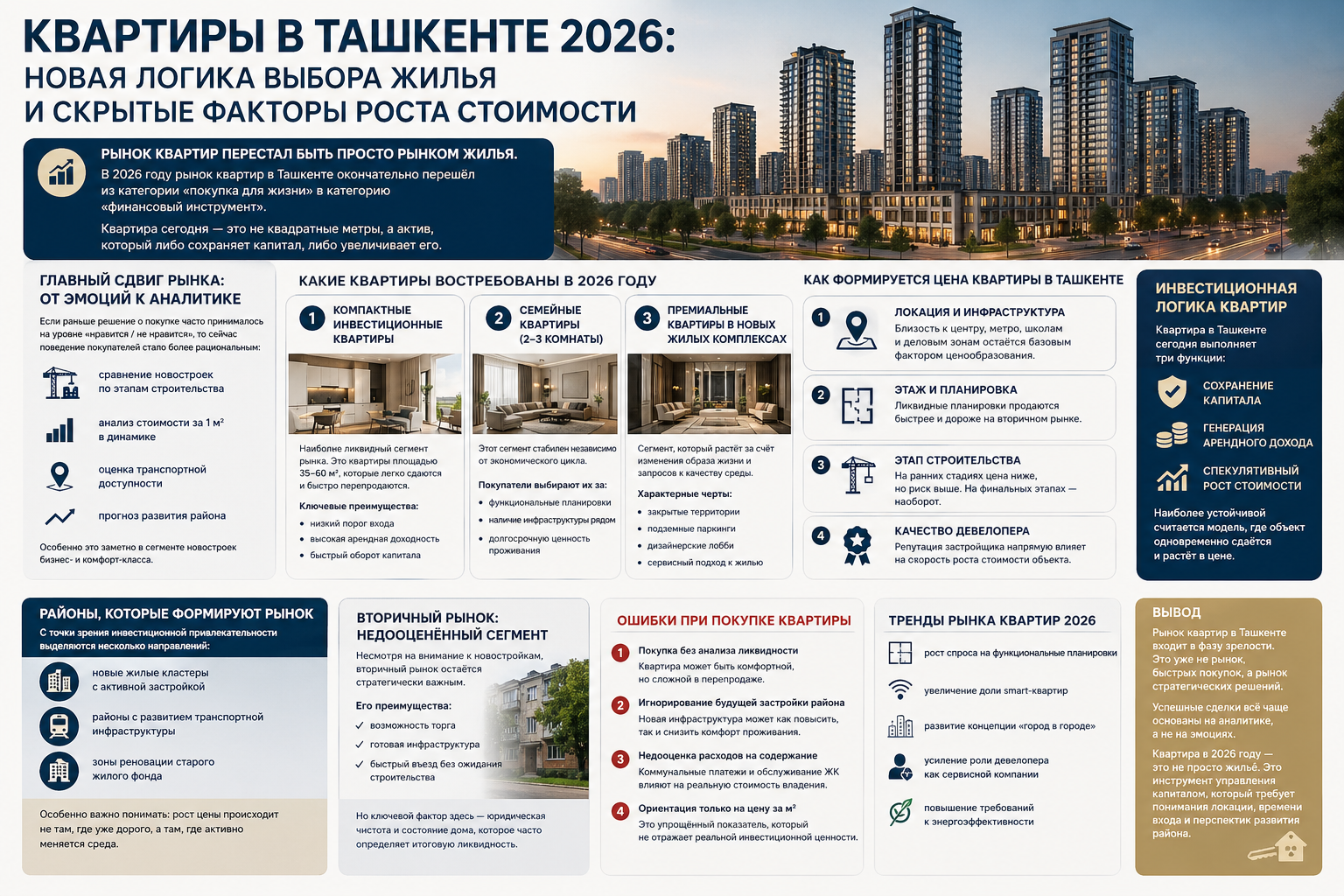
Apartments in Tashkent 2026: a new logic for choosing housing and hidden drivers of value growth
The apartment market has ceased to be just a housing market. In 2026, Tashkent’s apartment market definitively moved from the category of “buying for living” to the category of a “financial instrument.” Buyers are increasingly analyzing not only the layout and renovation, but also the property’s investment model: liquidity, price growth rates, rental potential, and the area’s infrastructure load. Today, an apartment is not square meters, but an asset that either preserves capital or increases it.
Author: Lika
Published: May 01, 2026
Views: 0
The market’s main shift: from emotion to analytics If earlier a purchase decision was often made on the level of “like / dislike,” now buyer behavior has become more rational: comparison of new developments by construction stage
analysis of the price per 1 m² over time
assessment of transport accessibility
forecast of the district’s development This is especially noticeable in the business- and comfort-class new-build segment. Which apartments are in demand in 2026
1. Compact investment apartments The most liquid segment of the market. These are apartments with an area of 35–60 m² that are easy to rent out and quick to resell.
Key advantages: low entry threshold
high rental yield
fast capital turnover
2. Family apartments (2–3 rooms) This segment remains stable regardless of the economic cycle.
Buyers choose them for: functional layouts
nearby infrastructure
long-term living value
3. Premium apartments in new residential complexes A segment that is growing due to changes in lifestyle and expectations for the quality of the environment.
Distinctive features: gated territories
underground parking
designer lobbies
a service-oriented approach to housing
How the price of an apartment in Tashkent is determined The cost per square meter has long depended on more than just the district. In 2026, the key factors look like this:
1. Location and infrastructure Proximity to the city center, metro, schools, and business districts remains a fundamental pricing factor.
2. Floor and layout High-demand layouts sell faster and at higher prices on the secondary market.
3. Construction stage At early stages, the price is lower, but the risk is higher. At final stages, it is the opposite.
4. Developer quality The developer’s reputation directly affects the rate of growth in the property’s value. Investment rationale for apartments
An apartment in Tashkent today serves three functions: Capital preservation
Rental income generation
Speculative value growth The most sustainable model is considered to be one in which the property is both rented out and increasing in value. Districts shaping the market From the perspective of investment appeal, several areas stand out: new residential clusters with active development
districts with expanding transport infrastructure
old housing stock renovation zones It is especially important to understand: price growth happens not where it is already expensive, but where the environment is actively changing. Secondary market: an undervalued segment Despite the attention paid to new developments, the secondary market remains strategically important.
Its advantages: room for negotiation
established infrastructure
quick move-in with no need to wait for construction to be completed But the key factor here is the legal soundness and condition of the building, which often determine its ultimate liquidity. Mistakes When Buying an Apartment
In the Tashkent market, the following miscalculations are the most common:
1. Buying without analyzing liquidity An apartment may be comfortable, but difficult to resell.
2. Ignoring future development in the area New infrastructure can either improve or reduce living comfort.
3. Underestimating maintenance costs Utility payments and residential complex maintenance affect the real cost of ownership.
4. Focusing only on the price per m² This is a simplified indicator that does not reflect the true investment value. Apartment Market Trends 2026
The market is developing in several directions: growing demand for functional layouts
an increasing share of smart apartments
the development of the “city within a city” concept
the strengthening of the developer’s role as a service company
higher requirements for energy efficiency
Conclusion The apartment market in Tashkent is entering a phase of maturity. It is no longer a market of quick purchases, but a market of strategic decisions. Successful deals are increasingly based on analytics rather than emotions. An apartment in 2026 is not just housing. It is a capital management instrument that requires an understanding of location, timing of entry, and the development prospects of the area.